
 Sage Advice UK Blog
 Landlord tax calculator for rental income
Use our free landlord tax calculator to estimate your rental income tax bill, understand how expenses and mortgage interest relief affect what you owe, and prepare for upcoming tax changes affecting UK landlords.


Rental income might seem straightforward at first. The rent comes in, you pay your mortgage, and whatever’s left is yours. But when HMRC gets involved, things start to look a bit different.
Most landlords will either overpay by missing legitimate deductions, or underpay without realising it. Either way, the gap usually comes down to a few numbers you never thought to check.
In this article, we share a landlord rental income tax calculator, so you can get a working estimate of your tax bill.
We also cover how the calculator works, what expenses you can deduct, and how mortgage interest relief is applied.
We explain the changes affecting landlords, including the April 2027 tax rate increases and the Making Tax Digital rollout, which began in April 2026.
Get ahead of Making Tax Digital
Whether you’re a sole trader, accountant, bookkeeper, small business owner, or landlord, Sage has the tools you need to start now and confidently meet MTD deadlines.

Landlord rental income tax calculator
Here’s how the landlord rental income calculator works:
The calculator is built for individual landlords who own property in their personal name (not a professional limited company), pay income tax on their rental profits, and pay tax at England and Northern Ireland income tax rates and thresholds. Which rates apply depends on where you live as a taxpayer, not where the property is located, so the results may not be accurate if you’re subject to Scottish or Welsh income tax rules.
The calculator also makes some important assumptions about your circumstances. It assumes that:
- You have 100% beneficial ownership of the property
- You’re an individual landlord, so it doesn’t apply to properties held through a limited company
- Your situation is straightforward. More complex circumstances, such as trusts, overseas property, non-resident landlords, and certain ownership structures, are not included in the calculation
Before you start, it helps to have a few figures to hand:
- Your monthly rent
- Your annual allowable expenses
- Your mortgage details
- Your other income from employment or self-employment
That last point is worth paying attention to, because your rental profit sits on top of your other income when HMRC works out which tax band you fall into.
On the mortgage side, you can select interest only or capital repayment. For capital repayment mortgages, you’ll need your outstanding balance and the annual mortgage interest rate, as the calculator uses it to separate out the interest portion. This interest figure is an estimate based on a simplified calculation, so it may differ from the actual interest shown on your lender’s annual mortgage statement. For interest only, you’ll need to enter your monthly mortgage payment.
The calculator then applies the Section 24 rules automatically. More on how that works in the mortgage interest section below.
The calculator also accounts for:
- The personal allowance of £12,570, which tapers by £1 for every £2 your total taxable income exceeds £100,000
- The standard tax bands: 20% on income from £12,571 to £50,270, 40% on any further taxable income of up to £125,140 and 45% on anything above that
The calculator doesn’t include National Insurance, payments on account (the advance payments HMRC requires toward your next tax bill once you owe more than £1,000), property losses carried forward from previous years, or the carry forward of unrelieved mortgage interest.
Note: the results are indicative estimates only, based on simplified assumptions. They are not a substitute for professional tax advice or an actual HMRC tax calculation, and your actual liability will depend on your individual circumstances and HMRC rules. Think of the calculator as a starting point for understanding your position.
Landlord tax rates explained
Landlords must pay income tax on profit, not on the full rent received. Once you subtract your allowable expenses from your total rental income, whatever remains is your taxable profit.
If you rent out more than one property, HMRC treats all income and costs as a single property business, so profits and losses across every property you own are pooled into one taxable profit figure.
Keep in mind, your rental profit doesn’t get taxed in isolation. It stacks on top of your other income, and that combined total determines which tax band you fall into.
- Tax-free allowance (personal allowance): 0% on taxable income up to £12,570
- Basic rate: 20% on taxable income between £12,571 and £50,270
- Higher rate: 40% on taxable income between £50,271 and £125,140
- Additional rate: 45% on any taxable income above £125,140
The personal allowance of £12,570 is applied first, though it tapers away once your total income exceeds £100,000, and disappears entirely above £125,140.
If your allowable expenses exceed your rental income in a tax year, you make a loss. That loss can’t be offset against any other income, such as your salary, but it does carry forward and reduces your rental profits in future years. Keep in mind that the calculator doesn’t account for losses carried forward, so if you’re using earlier losses to reduce this year’s profit, your actual bill may be lower than the estimate.
What’s changing from April 2027
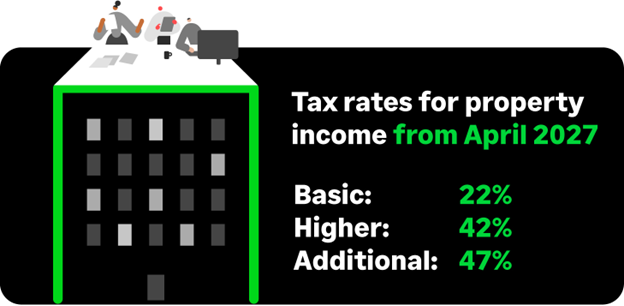
From 6 April 2027, rental profits will be taxed at separate rates above the standard income tax bands. Confirmed in the Budget 2025, the separate rates of tax for property income will apply to individual landlords in England, Wales, and Northern Ireland:
- Property basic rate: 22%
- Property higher rate: 42%
- Property additional rate: 47%
An additional 2% across every band doesn’t sound like much, but for higher-rate and additional-rate taxpayers with meaningful rental income, it adds up quickly.
If your buy-to-let margins are already tight, now is a good time to run the numbers and understand the impact before April 2027.
What expenses can a landlord deduct?
Not every cost you incur as a landlord reduces your tax bill. HMRC only allows you to deduct expenses that are wholly and exclusively for the purpose of renting out the property.
Get this wrong and you could either over-claim and face a penalty, or under-claim and pay more tax than you need to.
Common allowable expenses
These are some of the costs you can deduct from your rental income before working out your taxable profit:
- Letting agent fees and management fees: Fully deductible if you use an agent to find tenants, collect rent, or manage the property.
- Repairs and maintenance: Any work that restores the property to its original condition, such as fixing a broken boiler, replacing damaged roof tiles, or redecorating between tenants.
- Buildings and contents insurance: Standard landlord insurance premiums are an allowable expense.
- Service charges and ground rent: Deductible if you own a leasehold property and pay these costs yourself.
- Accountant fees: Deductible if incurred for preparing your rental accounts or tax return.
- Council tax, gas, water, and electricity: Claimable where you pay these bills rather than the tenant.
- Legal fees: Allowable for leases of a year or less, or for renewing a lease of less than 50 years.
- Direct costs: Phone calls, stationery, advertising for new tenants, and a proportion of vehicle running costs for journeys made solely for your rental business.
- Replacement of domestic items: The cost of replacing furnishings or appliances on a like-for-like basis, such as a sofa, fridge, or carpet. Covers replacements only, not the original purchase.
Expenses you can’t usually claim
Some costs feel like they should be deductible but aren’t. The most common ones landlords get caught up in include:
- Property purchase costs: The price you paid, including stamp duty on purchase, cannot be deducted against rental income. These are capital costs.
- Capital improvements: Any addition to the property that wasn’t there before, such as an extension, a higher-specification kitchen, or a new security system. Keep records of these as they may reduce a CGT bill when you sell.
- The full mortgage payment: Only the interest element counts. And even then, it’s handled through the Section 24 credit system, not as a direct deduction. The capital repayment portion is not deductible.
- Personal use costs: Where an expense covers both personal and rental use, only the rental proportion can be claimed.
- Clothing: Not deductible, even if purchased specifically for property-related meetings.
Mortgage interest and buy-to-let tax relief
If you have a mortgage on your rental property, the way tax relief works might not be what you’d expect, especially if you’ve been a landlord since before 2017. The rules changed significantly, and what was once a straightforward deduction is now a credit system that works quite differently.
How mortgage interest tax relief works now
Before April 2017, landlords could deduct mortgage interest directly from their rental income before calculating their tax bill. That’s no longer the case for residential properties held in the name of an individual.
Under the current rules, known as Section 24, mortgage interest is not treated as an allowable expense. Instead, you receive a tax relief credit, applied against your final income tax bill.
The credit is calculated as 20% of whichever is lowest:
- Your annual mortgage interest
- Your rental property profit
- Your adjusted total income above the personal allowance (excluding savings and dividends income)
A few things follow from this that catch landlords off guard:
- Higher and additional rate taxpayers get less relief than they used to: The credit only ever offsets tax at the basic rate, regardless of the rate you actually pay. Someone who previously deducted mortgage interest at 40% now only gets relief at 20%.
- Your taxable rental income looks higher on paper: Because mortgage interest is no longer deducted before your profit is calculated, your total income figure is inflated compared to the old system.
- The £100,000 threshold becomes a real risk: Because Section 24 inflates your income on paper, some landlords lose part or all of their personal allowance even when their real-world profit hasn’t changed.
In cases where mortgage interest exceeds rental profit, the credit is capped at the lower figure, so you won’t get relief on the full interest amount. Under HMRC rules, any unrelieved mortgage interest can usually be carried forward and set against future rental profits. The calculator doesn’t model this carry forward, as it’s outside the scope of the estimate.
How the calculator accounts for mortgage interest
The calculator handles Section 24 automatically. Rather than subtracting mortgage interest from your rental income, it calculates your full tax liability first, then applies the 20% credit at the end.
Using the example figures in the calculator: with an outstanding mortgage balance of £120,000 at an annual interest rate of 4.50%, the annual mortgage interest works out to £3,120. Twenty percent of that gives a Section 24 credit of £624, which is then deducted from the total Income Tax bill rather than from the rental income itself.
For interest only mortgages, every monthly payment is treated as interest. For capital repayment mortgages, the calculator uses your outstanding balance and interest rate to isolate the interest portion, since only that element counts toward the Section 24 credit. Keep in mind this is a simplified estimate, and the figure may differ from the actual interest charged by your lender over the year.
Example landlord tax calculation
Numbers on a page only go so far. Running through a real example tends to make things click a lot faster, so here’s how the calculation works in practice using the figures from the calculator above.
Here’s an example of someone called Sarah:
| Monthly rent | £5000 |
| Employment income | £25,000 |
| Other income | £40,000 |
| Annual allowable expenses | £4,450 |
| Mortgage | Interest-only, £120,000 at 4.50% |
| Annual mortgage interest | £5,400 |
Step 1: work out rental profit
Mortgage interest isn’t deducted from rental income under Section 24, so Sarah’s taxable property income is simply her annual rent minus allowable expenses:
£60,000 – £4,450 = £55,550
Step 2: add everything together
Rental profit sits on top of all other income, not separately:
- Employment income: £25,000
- Other income: £40,000
- Taxable property income: £55,550
- Total income: £120,550
Step 3: work out the personal allowance
Sarah’s total income exceeds £100,000, so her personal allowance tapers. For every £2 over the threshold, she loses £1 of allowance:
- £120,550 – £100,000 = £20,550 over the threshold
- £20,550 ÷ 2 = £10,275 reduction
- £12,570 – £10,275 = £2,295 personal allowance remaining
Step 4: taxable income
£120,550 – £2,295 = £118,255
Step 5: apply the tax bands
- Basic rate (20%) on £2,296 to £39,995: £7,540
- Higher rate (40%) on taxable income between £50,271 and £112,570: £29,948
- Additional rate (45%) on £114,866 to £120,550: £2,558
- Total Income Tax before credit: £40,046
Step 6: apply the Section 24 credit
20% of £5,400 mortgage interest = £1,080 credit
£40,046 – £1,080 = £38,966 total tax due (on all sources of income, including employment)
So on £60,000 of rental income, Sarah’s actual tax bill comes to £38,966 (but some tax may already have been deducted at source on any salary as PAYE).
One thing worth paying attention to here is how much the rental income affects Sarah’s overall position. Without it, her personal allowance would be intact, and she’d sit comfortably in the higher rate band.
The rental income pushes her total earnings to £120,550, wipes out most of her personal allowance, and tips a portion of her income into the additional rate of 45%. Section 24 makes this worse than it might look, because the full rental profit (not the profit after mortgage interest) is what counts toward her total income figure.
Do I have to pay Capital Gains Tax?
Capital Gains Tax (CGT) doesn’t apply to rental income but it does come into play when you sell a property and make a profit.
The taxable gain is the difference between what you originally paid and what you sold it for, minus:
- Stamp duty paid on purchase
- Solicitor and estate agent fees
- The cost of any capital improvements, such as an extension or conversion
Day-to-day maintenance and repairs don’t count here. Neither does mortgage interest.
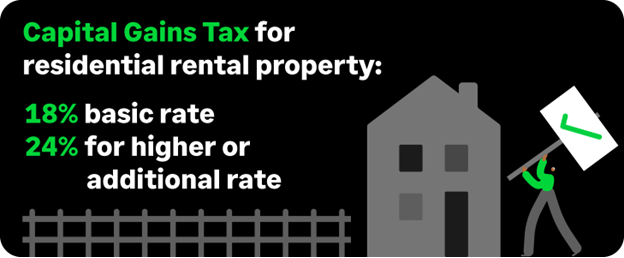
The CGT rates on residential property are:
- 18% where the gain falls within the basic rate Income Tax band
- 24% where it falls into the higher or additional rate band
Each individual also has an annual CGT exempt amount of £3,000. So, you don’t pay anything on the first £3,000 of gains in a tax year.
To work out which rate applies to you, add your taxable gain to your total income for the year. Any portion that pushes you over the basic rate threshold is taxed at 24%.
It’s worth knowing that when you sell a residential property, and CGT is due, you have 60 days from completion to report it to HMRC and pay what you owe. If you miss the deadline, penalties and interest follow.
Capital Gains Tax Reporting is not to be confused with your Self Assessment tax return.
If the property was your main home at any point during ownership, you may qualify for Private Residence Relief, which can reduce or wipe out the taxable gain for that period. It’s worth looking into if you lived in the property before you started letting it out.
Do all landlords need to complete a tax return?
Not every landlord needs to file a Self Assessment tax return, but most do. You need to register and report your rental income if:
- Your rental income before expenses is more than £10,000 in a tax year, or
- Your rental profit after expenses is more than £2,500
If your income falls between £1,000 and £2,500 after expenses, contact HMRC directly rather than file a return. If your rental income is £1,000 or less, the property allowance means nothing is due, and nothing needs declaring.
If you haven’t filed a Self Assessment return before, you need to register with HMRC by 5 October following the end of the tax year in which you received rental income.
Making Tax Digital for landlords
Since 6 April 2026, the annual Self Assessment return has been in the process of being replaced with digital record-keeping and quarterly reporting. If you’re a landlord, whether this affects you depends on your gross rental income combined with any self-employment income, not your employment income through PAYE, which doesn’t count toward the threshold.
The rollout is phased, and the first stage is already in effect:
- April 2026 (now live): qualifying income over £50,000 in the 2024/25 tax year
- April 2027: qualifying income over £30,000 in the 2025/26 tax year
- April 2028: qualifying income over £20,000 in the 2026/27 tax year
If you jointly own a property then only your share counts. HMRC will write to landlords it identifies as being in scope, but don’t wait for that letter, as the responsibility to register is yours. If your qualifying income was over £50,000 in the 2024/25 tax year, the rules already apply to you, and you should be keeping digital records now, with your first quarterly update due by 7 August 2026.
Once you’re in, you’ll need HMRC-compatible software to keep digital records and submit four quarterly updates a year, with a final declaration due by 31 January of the following year. One thing to note: mortgage interest must always be recorded separately from other expenses, even if you use simplified three-line accounts for everything else.
Sage is an HMRC-recognised Making Tax Digital software provider. Find out more at Sage for landlords or read the full guide on Making Tax Digital for Income Tax: what landlords need to know.
Landlord tax FAQs
Can you avoid paying tax on rental income?
Not outright. Rental income is taxable and HMRC expects it to be declared. What you can do is claim every allowable expense you’re entitled to, which then reduces your taxable profit.
Common ones landlords miss include accountant fees, replacement domestic items, and a proportion of phone or travel costs used for the rental business. Losses from one property can also be offset against profits from another, with any unused losses carried forward.
Is it better to be a limited company as a landlord?
It depends. Companies pay corporation tax as low as 19% on smaller profits rather than income tax at 40% or 45%, and can still deduct mortgage interest in full, unlike individual landlords under Section 24.
The downside is cost and complexity. Transferring existing properties into a company typically triggers Stamp Duty Land Tax and potentially Capital Gains Tax. Also, mortgage rates for limited companies are typically higher.
For landlords buying new properties to hold long-term, forming a limited company can make sense. For those with existing portfolios, the transfer costs often outweigh the savings. A property tax specialist is worth consulting before deciding.
What is the difference between a repair and a renewal?
A repair restores something to its original condition and is an allowable expense. A renewal or improvement that enhances the property beyond its original state is capital expenditure, which can’t be offset against rental income, though it may reduce your Capital Gains Tax bill when you sell.
HMRC’s BIM46901 sets out the general rules: replacing part of an asset is a repair; replacing the whole asset is capital. Using modern materials doesn’t disqualify a repair, provided the replacement is broadly equivalent to what it replaced. Replacing single glazing with double glazing, for instance, is now accepted as a repair.
Fitting something that didn’t previously exist, however, is capital regardless of cost. BIM46911 covers worked examples if you want to go into the details.
What is the property allowance?
Every individual landlord gets £1,000 of rental income tax-free each tax year through the property allowance. If your total rental income stays below that, there’s nothing to declare and no tax to pay.
Once you go over £1,000, you pick between using the allowance or deducting actual expenses from your income. Most buy-to-let landlords spend well over £1,000 running their properties, so claiming expenses is usually the better option. Joint owners can each claim their own £1,000 against their share of the income.
Is rental income taxed before or after expenses?
After. Tax is calculated on your rental profit, not the rent you receive. You deduct allowable expenses first, and whatever remains is what HMRC taxes.
Mortgage interest works differently. Under Section 24, it’s not deducted from your income upfront. Instead, you get a 20% tax credit applied at the end. The result is that your taxable rental income looks higher than your actual take-home, which can nudge you into a higher tax band or erode your personal allowance.
Do landlords pay National Insurance on rental income?
No, rental income is not subject to national insurance for individual landlords. It’s one of the few areas where property income is treated more favourably than employment income. That said, some landlords make voluntary Class 2 or Class 3 contributions to keep their state pension record intact. Whether that applies to you depends on your wider circumstances.
Is rental income taxed differently if I’m employed?
The rates are the same, but your rental profit gets added on top of your salary when HMRC works out what you owe. So, if your job already puts you in the higher rate band, your rental profit gets taxed at 40% from the first pound. Push past £100,000 in total taxable income and your personal allowance starts reducing too, which quietly increases your effective rate further.
Your salary will continue to be processed through PAYE as normal – you’ll just need to register for Self Assessment to declare the rental side separately.
*This article was verified by a UK-based Accountant in January 2026. Accounting rules are complex and change frequently and we recommend you seek any accounting advice from a qualified accountant or tax professional.
Browse more topics from this article
Explore more wisdom

VAT Calculator: use now to add & remove VAT
Calculate VAT quickly and accurately with our free VAT calculator (estimator). Whether you’re adding VAT to a price or working out the VAT amount included in a total, this tool helps you make the calculation in seconds. It’s ideal for businesses, sole traders and anyone who needs a simple way to manage VAT calculations.




The post Landlord tax calculator for rental income appeared first on Sage Advice UK.
 The Tax Sale Podcast - Investing in Tax Deeds & Tax Liens
  Providence Business News
  Dynamic Business
 Short Term Sage
  BBC News » Technology
  Guido Fawkes