
 Cancer Research Institute Blog
 For more than 70 years, CRI has been at the forefront of cancer immunotherapy – driven by deliberate investment in exceptional people and a relentless focus on the biology that fuels breakthrough discovery.
Today, the field has reached an inflection point. Data is no longer just a supporting tool; it is the engine that powers every stage of immunotherapy development. Advances in genomic profiling, single-cell and spatial technologies, and real-world patient data now offer unprecedented resolution into how the immune system recognizes and responds to cancer.
When harnessed effectively, data enables scientists to ask better questions, iterate faster, and design more precise therapies. It sharpens early discovery by revealing new targets, strengthens preclinical research by elucidating mechanisms, and guides clinical development by elucidating response, resistance, and combination strategies—bringing clearer insight and greater confidence as treatments move closer to patients.
CRI’s Investment in Data
Over the past several years, CRI has made deliberate investments to position the cancer immunotherapy field for the data era. As data becomes central to discovery, our focus is not only on access, but on ensuring scientists can interpret, integrate, and act on increasingly complex information to generate meaningful insights.
Explore how how CRI turns complex biological data into discovery-driving tools, training, and platforms that power the next breakthroughs in cancer immunotherapy.
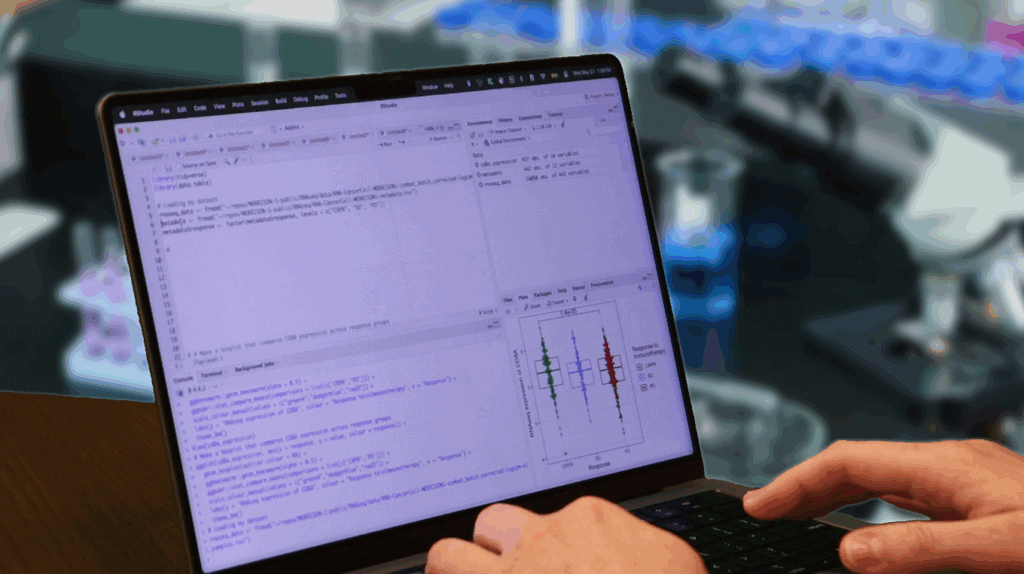
That commitment begins with people. In 2022, CRI launched the Immuno-Informatics Fellowship to invest in computational biologists applying advanced analytic approaches to immuno-oncology—scientists already fluent in computation, now applying their expertise to push the field forward. In parallel, we created the Bioinformatics Bootcamp to upskill traditional bench scientists through an immersive, hands-on program that builds fluency in single-cell, genomic, and spatial data analysis. Together, these programs ensure that CRI Fellows can move seamlessly from data generation to data interpretation, accelerating discovery and preparing the next generation of leaders for a data-first research landscape.
At the same time, CRI sustains and advances critical shared resources for the global research community. We have supported cornerstone databases such as ImmGen and iAtlas.
ImmGen, a long-standing collaboration across immunology and computational biology labs, provides a foundational map of gene activity and regulation across the immune system. iAtlas offers an interactive platform and analytical toolkit to explore tumor–immune interactions across cancer types, enabling deeper insight into immune contexture, response, and resistance.
Together, these investments in talent, training, and shared data resources position CRI to help the field adapt—and to lead confidently into a data-first future.
What Comes Next
CRI is extending our leadership into a new era—one where computational insight and biological expertise converge to accelerate discovery at scale.
In the months ahead, we will launch new initiatives that deepen how data is used across our programs. Central to this effort is our role as a convener, bringing together leading minds from academia, industry, and the nonprofit sector to share knowledge, strengthen analytical capabilities, and tackle complex scientific questions collaboratively.
By integrating AI (artificial intelligence) and ML (machine learning) into this work, we aim to raise the field’s collective “batting averageâ€â€”helping scientists identify the most promising hypotheses earlier, focus resources where they matter most, and move faster toward ideas with outsized potential.
But this next phase extends beyond CRI. The future of immunotherapy will not be defined by any single institution or breakthrough, but by a global community connected through shared data, shared tools, and shared purpose. Greater precision in understanding the immune system is what will unlock faster discovery, more personalized treatments, and outcomes that once felt out of reach.
Behind every data point is a cancer patient who wants more time. And a future that still belongs only to them.
Data makes that future possible. And CRI is committed to building one of the most powerful engines of discovery—not just for our community, but for the field as a whole.
We are laying the foundation for a new era of immunotherapy—powered by data, guided by biology, and driven by the belief that what we uncover today can change the future of cancer, everywhere.
The next era of immunotherapy is data-first – and the work to power it is already underway.Â
The post Building the Data-First Future of Immunotherapy appeared first on Cancer Research Institute.

 NCEA Talk
  Washington Post » World
 Literacy Edventures Blog
 The College Investor
 GeekWire
 Education Rickshaw