 eSchool News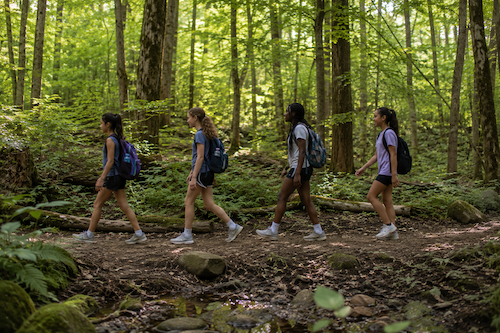
Key points:
- Outdoor education can improve academic outcomes across subjects
- The future researcher in every fifth grader: The case for curiosity-first teaching
- The 4 keys to creating meaningful student-led inquiry
- For more news on outdoor learning, visit eSN’s Innovative Teaching hub
As a school leader, you learn to recognize the moments that quietly reshape what students believe is possible for themselves. During our most recent spring break, I stood beneath the towering Sequoias and watched a group of middle school girls navigate a low ropes course, cheer each other across a creek, and set out on their first backcountry hike. It was one of those moments.
Our students were the first group of girls to attend R.M. Pyles Camp—a program with a nearly 75-year history of serving boys. That milestone matters. But what mattered more was what unfolded because of it—and what has stayed with students after returning to school.
For many of our students, this was their first time outside of an urban environment, their first time camping, their first time truly engaging with nature. They weren’t just learning how to read a trail map or cook over a fire. They were learning how to trust themselves—and each other.
Back on campus, it didn’t take long to see the difference.
Students who were previously hesitant to speak up started contributing more readily during class. Peer dynamics shifted—there was a stronger sense of encouragement and shared responsibility. These are not abstract outcomes; they are the direct result of learning that is physical, collaborative, and rooted in real challenge.
Research consistently supports what we observed. Outdoor education has been shown to improve academic outcomes across subjects, including science, reading, and math, while also strengthening motivation, well-being, and school engagement. Studies also link outdoor learning to increased attendance, improved behavior, and stronger relationships among students.
Equally important are the developmental benefits. Outdoor learning environments support confidence, independence, problem-solving, and leadership—skills that are difficult to cultivate through traditional classroom instruction alone. And for young people navigating adversity, adventure-based programs have been shown to increase confidence, character, and resilience.
At Girls Athletic Leadership School Los Angeles (GALS LA), we’ve long believed that movement is foundational to learning. When students move, they build confidence. When they build confidence, they take risks. And when they take risks, they begin to see themselves differently.
What this experience reinforced is that movement-focused education extends far beyond athletics. It lives in the act of hiking a trail, navigating a challenge course, or working as a team to solve a real problem in real time.
But access to these opportunities remains deeply uneven.
Schools serving higher percentages of low-income students are significantly less likely to offer outdoor learning experiences like field studies or overnight camps—and when they do, students often face barriers to participation. At the same time, broader forces—urbanization, funding constraints, and the pressures of standardized testing—continue to limit access to outdoor education nationwide.
This is what makes experiences like this one so meaningful. For our students—96 percent of whom are students of color and the majority from low- to moderate-income families—this was not just exposure to nature. It was access to a form of learning that too often remains out of reach.
The partnership between GALS LA and Pyles Camp offers a powerful example of what can happen when that access gap is addressed. It shows what becomes possible when students are placed in environments that demand both physical engagement and collective problem-solving.
And importantly, the impact doesn’t stay in the woods.
It comes back into classrooms, into group work, into how students carry themselves and support one another. It shows up in confidence, in persistence, and in a willingness to try.
If we are serious about supporting the full development of young people—academically, socially, and emotionally—we have to think more expansively about where and how learning happens.
Because sometimes the most important growth begins when students step outside—and discover what they’re capable of once they do.
 The LIFESEXPERTS Blog
  RealClearPolitics
  ClassTechTips Blog
 Idyllic Pursuit
  Conservative Home
  John Spencer Blog