 Doug Lemov's Field Notes Blog
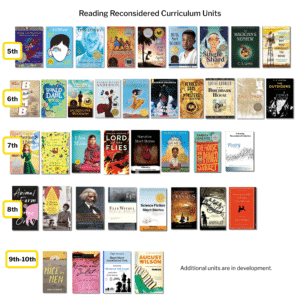
 One of the themes of The Teach Like a Champion Guide to the Science of Reading and a key a design principle of the Reading Reconsidered curriculum is the idea of re-centering the book.
Not only should students read great books cover to cover, they should read them together, in class, often aloud.
Among other things we can use shared reading to rebuild attentional habits so that students experience 8 or 10 or 12 minutes of uninterrupted and undistracted text several times a day.
Even better if we can breathe life into the text with a bit of our own and their peers’ expressive reading. It’s a richer text when read aloud, and experiencing it together makes for a shared and meaningful social experience for young people- something most need far more than staring at another screen.
Better yet if we can use the expressive oral reading to build fluency, which, as we point out elsewhere, is a hidden crisis.
But there are other benefits to re-centering the book through shared oral reading, and one of them is that it makes discussion better and more meaningful. And demonstrating that is my main purpose for this blog.
And so I present to you Jaime Johnson’s classroom at Bay Creek Middle School in Gwinnett County Georgia. This beautiful clip provides a road map for how to bring meaningful discussion back into your classroom.
For much of the clip, Jaime is using the FASE technique to read Grace Lin’s novel Where The Mountain Meets the Moon aloud with her 6th graders.
I’ll talk briefly about her use of FASE and why it’s not just joyful but effective but I’d also like to draw your attention to what happens after it, at the end of the clip, in particular.
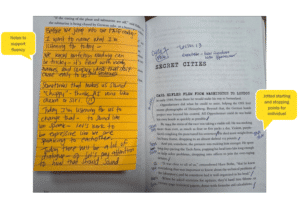
As the clip opens Jaime is describing to her students the “annotation task” they’ll be focusing on while they read. An annotation task like this causes students to read more attentively in general—to actively prioritize–and to attend in particular to key ideas- in this case the special piece of paper that the passage describes. Not coincidentally that’s what she’ll ask them to discuss at the close of the clip. The annotation task ensures they’ll notice lots of things to bring to that discussion.
Next they’re off and reading. Jaime’s use of FASE, which I’ve shortened slightly, is so artfully done that it deserves more time than I’m going to give it here but some of the things you’ll notice:
- The not-irrelevant fact that a buzz sweeps across the room when the students realize they’re going to be reading aloud. Look at the kids on the far right at about 22 seconds of the video. A great story is made greater when it’s read aloud and these students know that.
- Jaime read first with rich expression. She’s adding to the text and making its ideas and emotions fuller by reading it but she’s also modeling for students how to read aloud themselves. If she can get them to read aloud with prosody—expression that reflects understanding—research tells us it will help make them more fluent and expressive readers even when they read silently. Look at the class at 47 seconds. Everyone is locked in, head down in the book!
- Just after a minute of the video Jaime calls on Jack to read. His reading, too, is beautiful, expressive, thoughtfully bringing depth to the book.
- The several other readers whom Jaime’s lovingly prompts to read tricky words or phrases—“in a daze,” scrawled—more correctly or more fluidly. Her students also independently and without prompting self-correct to read more accurately and expressively linking words into phrases like “in the moonlight the page glowed.” It’s outstandingly curated fluency practice.
Then back to Jaime for a bit a few more lines of text ending with Jaime telling her class to draw a line under the last word, treasure, at 2:13 of the video.
Now Jaime is going to ask her students to discuss. “This piece of paper,” she says, “Let’s talk about this piece of paper.”–and this is the moment I really want to bring to the fore.
The first step is a Turn and Talk in which students will both have the opportunity to think through and rehearse their ideas before sharing them with the whole class. But the Turn and Talk also affords them the opportunity to read the room, to ask: If I’m called on the speak about the book will my classmates want me to speak? Will they care about what I say?
These questions are answered with a resounding yes at 2:28 of the clip. “Describe to your partner, what’s going on with this piece of paper? Where is it from? What’s significant about it?” Jaime asks, and the room explodes to life. Every child eager to talk about the scene from the book. Brother, we had to dial down the audio on the ambient mic to make this video. That is enthusiasm.
Discussion is critically important and we love it when we get this kind of buy-in. And yet such enthusiasm is a rare and fleeting thing.
But there are some basic and replicable reasons from these students’ respond so positively to the idea of discussion and and those reasons are connected to the reading they’ve just competed.
One of the things we know about working memory, the mental space where people hold ideas that they wish to think about, is that it is both small and fleeting. We can hold one or two ideas of substance in our working memory. And we start to forget what’s there within a few seconds.
Consider dual-factor authentication, which is the fancy name for someone sending a six digit code to your phone when you register for something online. An 8 digit code would be a lot more secure but six is about the most you can hope to remember. But even then it’s hard to remember! You may have to go back and forth a few times. And if you don’t try to type the code in right away, if you pause for a few seconds to order a coffee say or to read some other thing on your phone? Forget it! That code, the thing you wanted to remember, is gone from your memory.
Students remember a great book better than a six digit code but the principles still apply. Too often the things we want students to discuss are already fading to gray in their memory by the time we get around to it…. a bit like a six-digit code they were sent an hour ago. If you ask me to discuss a book—even one I loved—that I read yesterday or last night, my desire might be keen but memory will be imprecise, including my memory of why it was so meaningful.
But in Jamie’s classroom, students’ memory of the book is live and in vibrant color in their working memory. They remember more and with more depth and emotion because the discussion is so proximate to the experience of reading it…and of hearing it read beautifully and seeing all their other classmates engaged in it.
Their interest and insight is not only increased by the read aloud but it carries over seamlessly into the discussion because the two activities are so proximate.
It only takes 10-15 seconds for things to start fading from your working memory so even the speed of Jaime’s transition is important-as is the fact that everyone gets to share their initial thinking right away and therefore encode it into long term memory a little more. If she went right to discussion and Jack went first and spoke for a minute everyone else might start to forget their own insights. Here the brief interlude of telling a partner causes them to “externalize” their thinking and thus remember it better!
I have a friend I admire who says that English class is only for discussion. There’s too much to do and so the reading should happen at home or outside the classroom.
I would argue that he is profoundly wrong.
As Jaime shows us the act of reading together is in and of itself one of the most important things we can do with students—it builds their fluency and attention skills, it makes reading a shared meaningful experience, and it prepares them to discuss the book more fully, to find more meaning in it, to be sold on reading by the outcome of understanding: of having greater insights about events they care about as a result of reading and discussion.
If you’re in the UK and interested in learning more, we’ll be in Pembrokeshire, Wales in November leading a two day training on the Science of Reading where we’ll discuss the importance of re-centering the text and study practical tools to support comprehension and appreciation of those texts.
Thanks to the amazing Jamie Johnson and her students for sharing their work with us!
The post How Jaime Johnson’s Shared Reading Leads to More Vibrant Discussion appeared first on Teach Like a Champion.
 The Balanced Blonde
 Tim Ferriss
  The Next Hint
  Teacher Network
 Brian Solis
  Entertainment Tonight