
By Dr. Cindy Hou
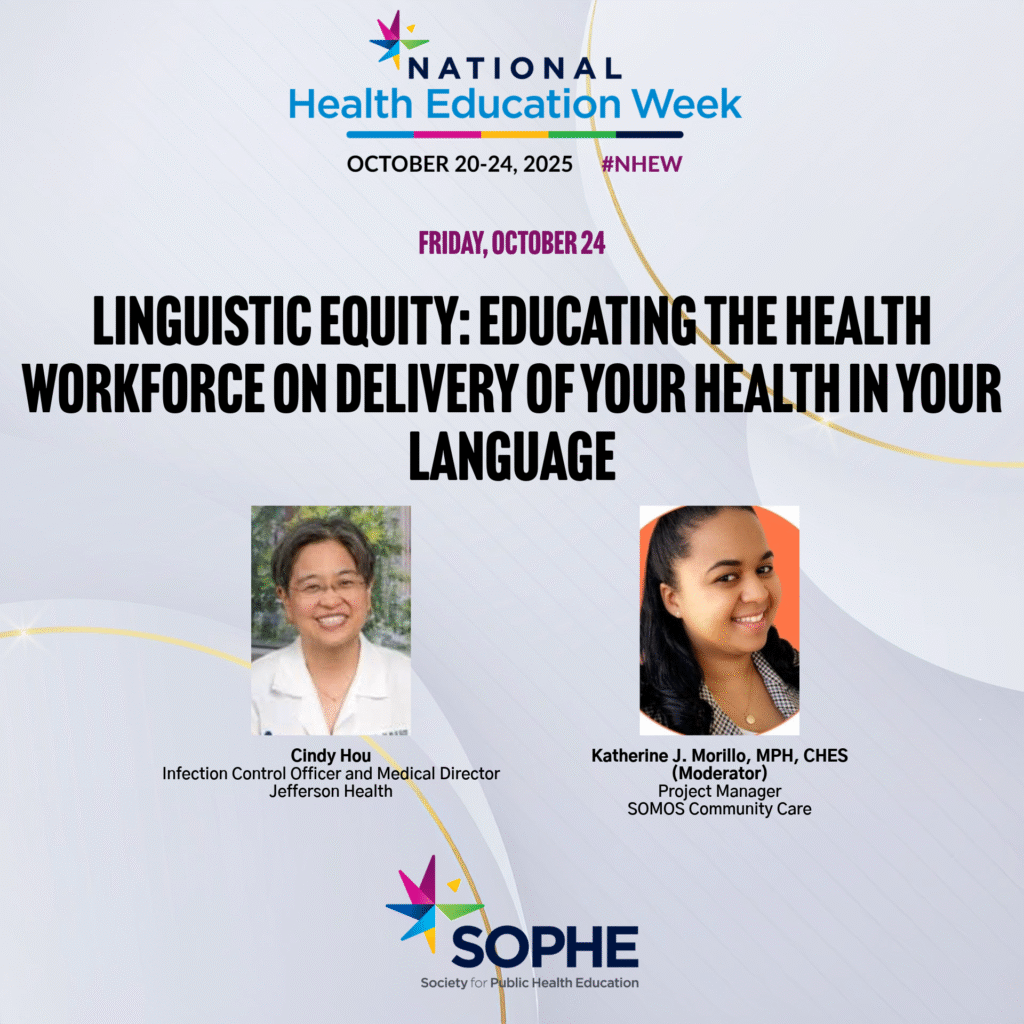
Editor’s note: This blog post is a lead into the author’s presentation on Linguistic Equity during National Health Education Week, titled “Linguistic Equity: Educating the Health Workforce on Delivery of Care in Your Language.â€
A few years ago, I was on vacation in Hawaii and clicked on an email. It said the equivalent of congratulations, but I had been rejected so many times before in grant applications that I thought, “Is this real?†I sent an incredulous email asking if this meant that we had won the grant. I’m not a big dancer by any means, but let’s just say that I did a mini-dance and celebrated with our grant team at Jefferson Health via email after getting confirmation.
Since then, life has been a journey of learning all about language access as it relates to health and healthcare. Our grant team says language access is like providing “Your Health in Your Language.†Back then, we received funding from the Office of Minority Health in their Promoting Access to Language Services initiative. We are now coming up on three years of this initiative, and recently we applied for and received a six-month no-cost extension to continue our work. Â
In the United States, there are over 68 million people who speak a language other than English. In people who have limited English proficiency, they may not understand, read, speak, sign, or write English very well. For sites that receive federal funding such as hospitals, these institutions may deploy certified medical interpreters via different modalities, such as in-person, video, or telephone. Other places may have trained qualified interpreters. In any case, this can be framed as a matter of linguistic equity—where every patient, regardless of their primary preferred language, has an equal opportunity to understand their care, communicate their needs, and make informed health decisions.
In today’s diverse communities, healthcare providers serve patients who speak different languages and come from a variety of cultural backgrounds. The federal government has established standards that can be utilized in many settings. Nationally, the Culturally and Linguistically Appropriate Services (CLAS) standards set the backdrop for ways to improve equity and to enhance the quality of care. The main themes include the following:
- Governance, Leadership, and Workforce
- Communication and Language Assistance
- Engagement, Continuous Improvement, and Accountability.
Providing culturally and linguistically appropriate services is important for everyone, not just those who speak a language other than English, but also those who speak English and who use sign language. As healthcare providers, we should utilize concepts just as teach-back and plain language. This means ensuring that key healthcare information is understood—by asking people to relay back what was explained to them.
Today, more than ever, attention to what we say and how we share information is critical, especially in healthcare settings. In this week’s webinar on “Linguistic Equity: Educating the Health Workforce on Delivery of Care in Your Language,†we will review key issues of utilizing medical interpreters, provide case examples of the benefits of having cultural and linguistic awareness, and discuss the importance of clear communication. Put very simply, the workforce should convey information in a way that anyone, anywhere can understand their health in their language.
The post Your Health in Your Language appeared first on Society for Public Health Education - SOPHE.