 Lew Lew sports
Bill Simons
There are reasons why clichés are clichés. And the biggest cliché in sports is “the thrill of victory and the agony of defeat.”
Today, after four hours and 38 minutes of battle, we saw it in one cataclysmic moment.
Unseeded Californian Alex Michelsen slipped under the radar to win. In the biggest match of his career, he was serving in the third set. But he blinked and gave his friend Francis Tiafoe the tiniest of openings.
And for only the third time in his career, Tiafoe pulled off an inexplicable victory from two sets down: 5-7, 3-6, 7-5, 6-3, 7-6(10-7) and reached the semi-finals of the US Open.
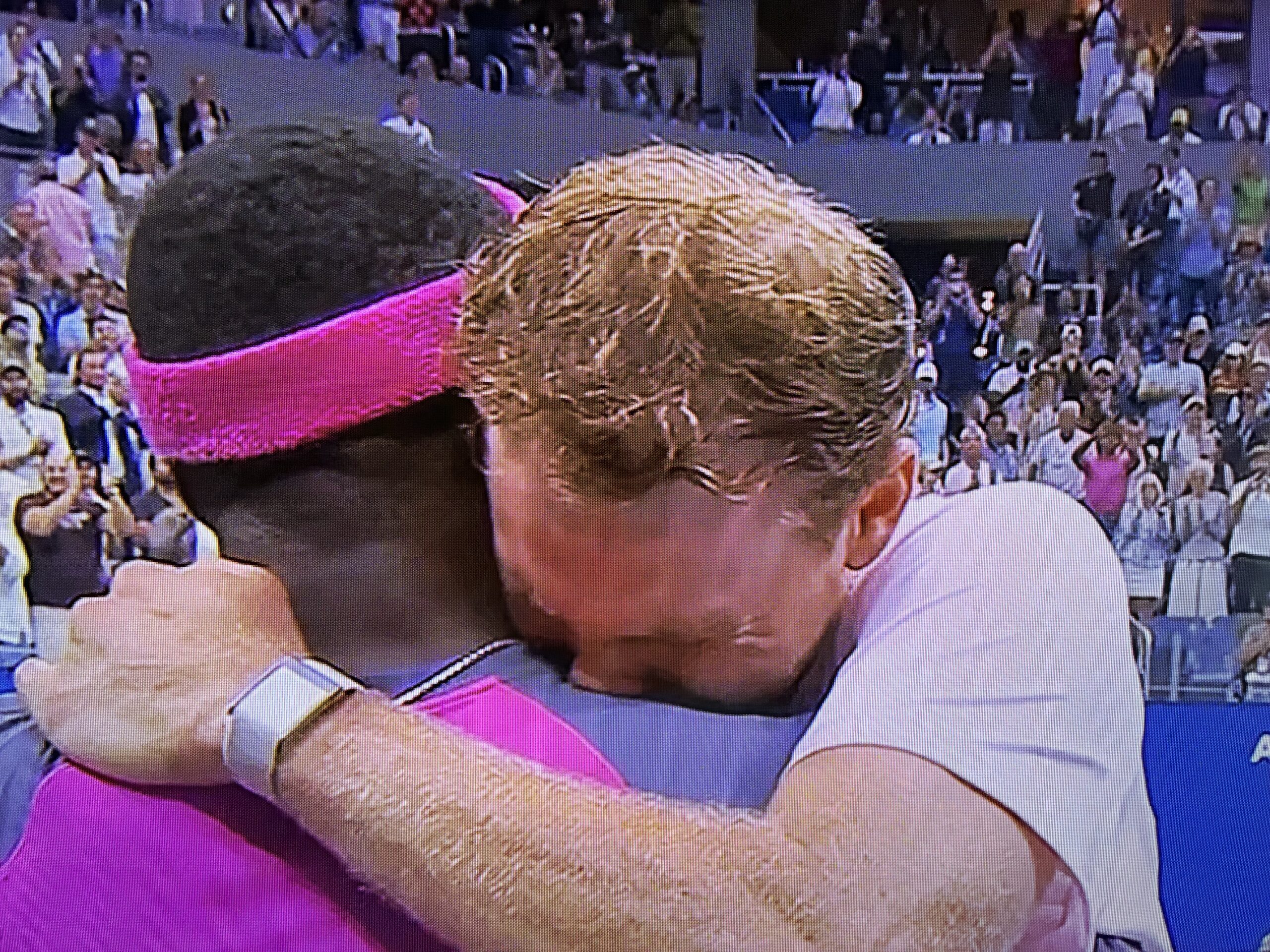
Then came the most indelible image of this year’s Open.
Tiafoe, one of the most beloved faces in tennis, came over and hugged his younger opponent. For 23 unforgettable seconds, Michelsen’s chest heaved. The tears flowed. His grief was deep. Lost opportunity.
How could it not hurt?
After all, the Southern Californian, who had shocked Brandon Nakashima in the second round, was on the front foot and looked to be on his way to the most stunning victory of his career.
This should not have happened.
Recently, in even-numbered years, Tiafoe has reached the semifinals of the US Open. He disposed of Daniil Medvedev with some ease at Louis Armstrong Stadium, where he posted a 10-0 record. He said that no one fled to the suites on Armstrong, that it was the people’s court.
A thought. If every tennis match was played on Armstrong, Tiafoe would be world No. 1.
But guess what? You can’t win the US Open with Louie.
And today, in the sleepy atmosphere of Ashe Stadium, Tiafoe’s delivery was shockingly low at the start. Michelsen, who was just playing Challenger in July, took full advantage, hitting his backhand deep, serving big and attacking Francis’ serve. He broke twice in the first set to lead 7-5, 6-3, 5-3.
But, as Andy Roddick pointed out, “there’s no way to talk sense into your nervous system.”
And the 6′ 6″ 22-year-old had a horribly poor performance, double-faulting, losing the third set and then reeling off seven straight losses as Tiafoe fought back.
Ash’s crowd grew now, and so did Francis. He channeled his inner Pete Sampras and served like a demon, hitting a monster ace when Michelsen had a break point in the fifth, then unleashing a fabulous forehand to grab the deciding game tiebreak, 10-7.
Michelsen had come so close. Victory was in his grasp until it all disappeared.
No wonder she was crying out of grief.
Who Knew Bonds COULD BE SO FUNNY? Roger Federer and Rafa Nadal famously broke into helpless laughter while trying to record a public service announcement. Now, Sam Querrey, John Isner, and Steve Johnson have done much the same thing in a sophisticated, overdubbed ad they read for Vanguard bonds on their excellent Nothing Major podcast. The three tripped, tripped and fell over the edge of the smile fest as they tried to get through the replica. In the end, Isner mocked his old friend Querrey. “Sam was starting to talk in slow motion.” Who knew bonds could create such high comedy?
WHO PLAYED IT? Alexander Zverev is in a commanding position in the upper part of the men’s draw. But who would have guessed that No. 70 Botic van de Zandschulp, No. 50 Karen Khachanov and No. 34 Alexander Blockx would be there with him.
French nonsense. Arthur Fils arrived in New York after beating Cincinnati and was picked by some to make a serious run at the US Open. Instead, Stephanos Tsitsipas knocked him out in the first round. Then, France’s beloved icon Gael Monfils bowed out in his final Grand Slam. In the end, lucky loser Arthur Gea came within a point of becoming the first lucky loser to ever reach a men’s Grand Slam quarter-final. He had a game point and later served for the match, but Bottic van de Zandshulp somehow escaped 3-6, 6-7, 7-6, 7-6, 6-4 after five hours and 13 minutes. Sacré bleu!
JUST RENTING. US Open midnight seed Alexander Zverev was asked if he owned the spot after winning four straight at Arthur Ashe Stadium. He answered: “This is not my court at all. Federer won here 78 times, Sampras 112 times. I just rented it for two weeks from 11pm to 2am. And hopefully they’ll keep dressing me at the same time.”
THE LATE, LATE SHOW. Simon Cambers notes that play ended after midnight on six of the first seven nights of the US Open. His most famous point. “I can’t think of another sport where fans are expected to pay top dollar to attend and then sometimes not stay for most of the action.” Players finish at 2 am and may not sleep until 5 or 6 am. Fans flee home while tournament workers and media endure marathon days; reporters covering the first week would work approximately 100 hours. Big drama is one thing. For everyone else, the endurance competition is something else.
GO TO PIC. Six Americans, three men and three women, have reached the quarterfinals of the US Open, the most since 2002. three women are the most since 2017.
BACK WITH COCO. Coco Gauff is the youngest American woman since Serena Williams in 2003 to reach three Grand Slam quarterfinals in the same year. He also claims that the last time he got tired was when he was 14. And then there are puzzles. In a great ESPN interview, Malika Andrews asked about the conundrums Coco revealed at this year’s Open. Monday. “What is it that stays in the corner but travels around the world?” Without hesitation, Andrews answered. – then flew away happily as if he had won the lottery. As for Coco’s training philosophy as a child, she was constantly told: “If you’re not bleeding, you’re not trying.”
WHAT A DIFFERENCE A YEAR MAKES. John Craig of Performance Plus Tennis in Newport Beach studied Coco Gauff’s redesigned serve and noticed significant changes in her sequence, rhythm and ball placement. Coco himself says his throw is now more consistent and less forward, so he doesn’t fall forward as much and he twists his wrist less. The fee: Gauff committed just six double faults in her last three games in the win over Cincinnati, and just one in the final against Jessica Pegula. Last year, Coco hoped her service would go through. Now he says he’s thinking about aces. That’s quite a difference.
EVERYONE ENTERS IT ENTERS THE US OPENING. The crowd isn’t just watching this year’s Open, they’re becoming part of the show. An employee of the practice court led the chant. “When I say Coco, you say Gauff!” At another game, when a rowdy fan wouldn’t stop talking trash, the crowd demanded he be ejected. And when the deep-throated, highly-acclaimed umpire Kader Nooni called “Deuce.” Louis Armstrong’s crowd enthusiastically responded to him. Audience participation, US Open style.
Once again, with FEELING. Last year, Jelena Ostapenko infamously told Taylor Townsend that she was “no class, no education.” This year it was the fiery Latvian again. In a controversial win over Taiwan’s Hsieh Su-Wei at Maia Joint and Taiwan’s Chan Hao-ching, Ostapenko complained that the opposing box was trash and sarcastically cheered their mistakes in Chinese. When the match ended, Ostapenko twice turned to her opponent and roared in defiance. Just another quiet day at the Open.
GEORGIA IS NO LONGER ON HIS MIND. Alex Michelsen’s parents, Sondra and Eric, both played college tennis, and Sondra hoped her son would follow suit. “I wanted him to go to college because it was so much fun,” he told USTA SoCal writer Steve Pratt. “Travelling and being with your teammates, football games and parties. It’s a good way to grow up a little bit, too.” But the Aliso Viejo, California, kid just got too good. Just ten days before leaving for the University of Georgia, Michelsen called legendary Bulldogs coach Manny Diaz to let him know that Georgia was no longer considering him. He was becoming a professional.
IN FOUR WORDS OR LESS, ABOUT THE BEST THING YOU HAD TO SAY TO ME. Alex Michelsen commented. “My backhand is clean.”
GO AWAY!ULD’s ALL-STAR LINEUP: When writer Richard Osborne asked legendary coach Dick Gould which six players he would select for Stanford’s all-time All-Star team, he replied: Wheaton, another top ten.”
 Silvia Reiche
  healthsystemCIO.com
  North Coast Financial
 Healthcare Dive
  Florida Politics
 G2 Blog